Lying

When I grew up, my parents taught me never to lie. As I raised my children I told them the same. Lying can be hurtful, misleading, and also leads you to feel bad about yourself. The purposes of lying are not noble, though I grant you the odd exception of what is often called the “little white lie” to avoid hurting someone’s feelings, or lying by omission for the same purpose. “How do I look?” does not always require a 100% truthful answer. Is this a slippery slope? If I answer “you look great” when you don’t, does that lead me to tell ever bigger fibs? Experience tells me not.

So what has gone wrong, that lying is the natural order of things. Every single day I read that the President of this great country tells a multitude of lies. He lies about gas prices. He lies about his election results. He lies about his predecessors. What is his purpose in telling these lies? He’s intelligent enough to know they are not true.

RFK Jr tells lies every day which are dangerous. He spouts statistics about health care that are made up.

I am sure that lying is not limited to Republican administration politicians, but the extent of it coming from Donald Trump is shameless, egregious and incredible. There are a lot of things that leaders should be – role model is one of them.

If I had young kids today I would be trying very hard to shield them from these role models.

Netanyahu, Trump

I have a serious dislike of Netanyahu and what he’s doing. It does NOT mean I don’t have respect for Israel. It’s the same as disliking Trump but not disliking USA.

I think Donald Trump is a global embarassment, a shyster and a mafia boss. As much as I cannot deny he was elected (by the thinnest margin in 25 years), I insist that he does not represent our country, what we believe in and what we stand for. Kudos for our neighbors to the north who elected a grown up – Mark Carney – as their new Prime Minister.

As much as I dislike Trump, I still love my country. I do fear that somme of our elements unique greatness are at risk, but I still love what we have always stood for, even if we haven’t always practiced it – fairness, freedom, rights , due process, and national pride.

I dislike what Netanyahu is doing as the autocrat running Israel, and I sense (from a safe distance) that many of his citizens are as unhappy with him as we are with Trump. What Hamas did in October of 2023 is of course horrendous. What Netanyahu is doing – continues to do – is just as bad, if not worse. Palestinians are not the problem, Hamas is. Palestinians were in this territory long before Israel moved in and took it from them. An agreement to share territory has been in sights for a long time, but Netanyahu has discarded this objective, treating Palestinians as non-citizens witout rights. What he’s done in the West Bank is disgusting. What he’s doing in Gaza is worse.

yet I still have respect for Israel, for what they stand for and for Israelis. Do not call me anti-semitic for being critical of Netanyahu and what he’s doing (oh, by the way, my blood is Ashkenazi jewish).

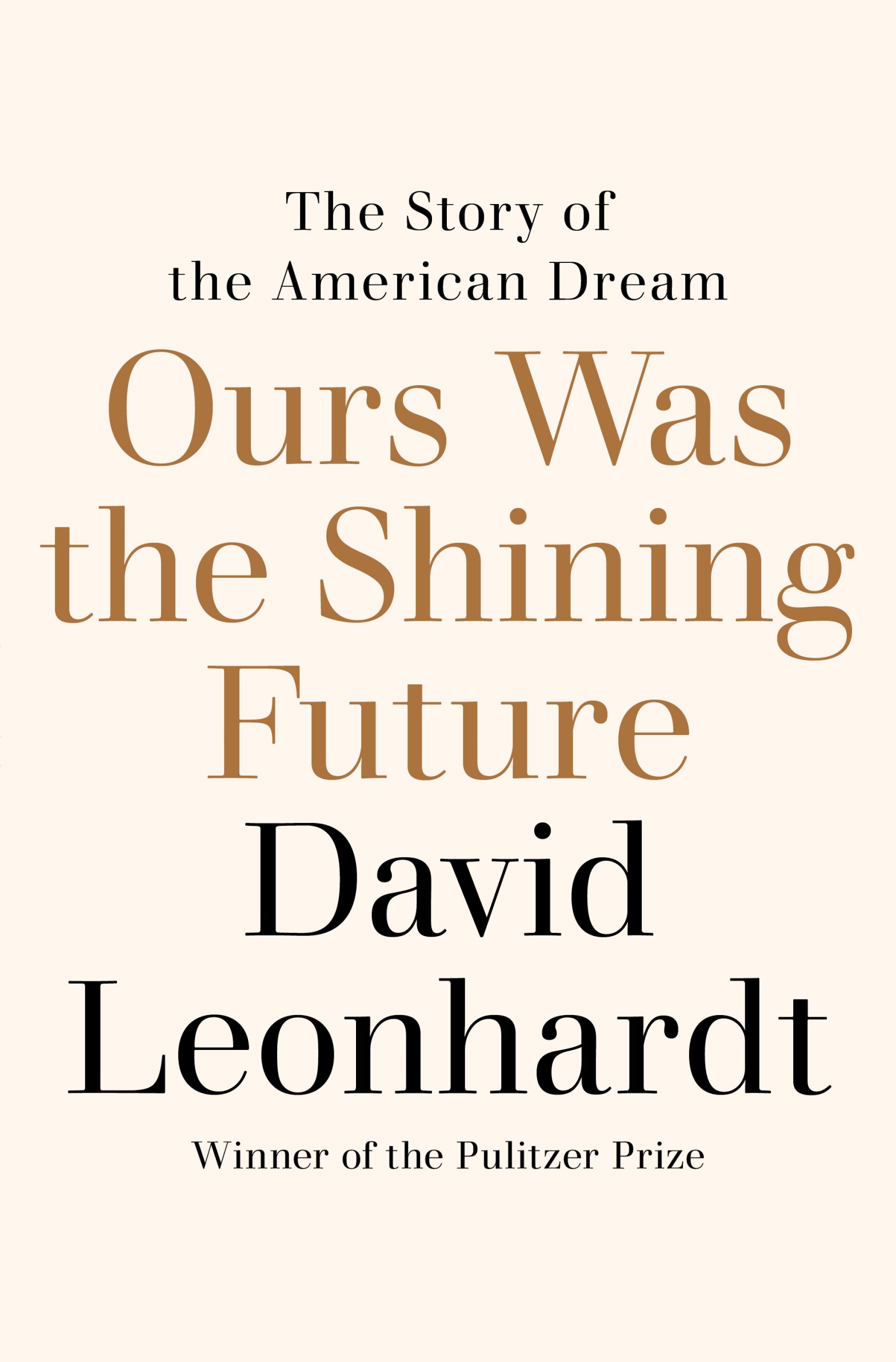
Ours Was the Shining Future

I just finished this fine book by David Leonhardt, a New York Times writer who has won the Pulitzer for his commentary in the past. It’s hard to imagine that a book about the history of America’s economy would be anything other than a text book type of read. He covers organized labor, immigration, the tug and pull of politics from the left and right, and the impact on what used to be called the American Dream. Leonhardt does it so well that I found myself taking notes, writing in the columns, dog-earing pages that I wanted to come back to in order to write this blog. I can’t resist sharing some of it….

Some of the lessons from history are instructive (as ever). I noted that when Eisenhower was elected he selected a cabinet made up of “nine millionaires and a plumber,” Ike’s choices were a departure from previous administrations – he chose wealthy corporate executives like the CEO of General Motors, Charles Wilson. When asked whether this might represent a conflict of interest, he famously said “I thought that what was good for the country was good for GM, and vice versa.” Stop me if any of this sounds familiar.

The book takes great pains to discuss how organized labor made an impact – workers could band together to improve their lot with their companies. A worker has little to no negotiating power with his employer, but a group of workers, represented by his union can suddenly command some negotiating power. Some history is instructive on this, but even more interesting is the impact on politics. The Democrats (the “left”) used to be the party that got credit for representing the interests of the working man (or woman). Some time after the 1960s, what Leonhardt calls the “new left” took their eyes off this ball. The New Left failed to create an enduring mass coalition. It didn’t even try. The New Left appealed to college-educated intelligentia. They focused on winning court cases about social issues, with judges who also came from privileged backgrounds. In the meantime, the political right, especially the religious right, stepped into the void and won grassroots victories.

The New Left believed that if college students and professors led the way, the rest of the country would follow. Less than 10% of people in the country held college degrees in the ’60s, and even today it’s only less than 40%. The New Left’s vision was not particularly attractive to most Americans. It was liberal and secular. It was not overly comfortable with patriotism. It was an elitist movement. Therefore – no surprise – college graduates moved left and working class voters moved right. This New Left has created a legacy of political activism. These activists tried to shift public opinion and pressure Congress to pass new laws. They have had success – protecting consumers from harm, reducing pollution, winning new rights for women, people of color and the LGBTQ community. However, the New Left movement never made mch of an attempt to improve the pay, benefits and job conditions of working-class Americans.

Thus the narrow focus of the New Left no longer had a mass movement to lift most Americans’ living standards. The left had split into two movements – a progressive elite movement and a group of largely self-interested labor unions. Many workers naturally began to question where their political loyalties should lie.

Along came Reagan – with his folksy charm and appeal to the common man, he swept into office with the power to change the key elements of the American economy. However, one of the key failures of this period is that this is when wealth began flowing to a relatively small and affluent segment of the population, while everyone elses grew more slowly. Reagan helped end the weak overall growth of the 1970s, but he ushered ina new era of unbalanced growth. His presidency invigorated the stock market and the financial well-being of the wealthy. For most families, however, it failed to deliver on its promise.

Okay let’s talk about immigration for a bit. Leonhardt’s chapter on this topic is educational. In the late 1960s, the foreign-born share of the US population was below 5%. It has since risen – I looked it up – to 15.6% in March of 2024. Immigration is a particularly thorny issue with a great deal of complexity. Questions of “who” and “how many” can be broken down. The 1965 immigration law did a poor job of anticipating its effects. It allowed relatives of residents, and those with key skills to enter the country and effectively opened the floodgates inadvertantly.

Immigrants have done well in the US, to a great extent. Leonhardt explores why – they show up with grit and ambition; more than some citizens. They have already shown a willingness to uproot and move, which most Americans prefer to avoid.

President Clinton asked Congresswoman Barbara Jordan to lead a commission on the issue of immigration strategy. She said “immigration is not a right, guaranteed by the US Constitution to everyone anywhere in the world who thinks they want to come to the United States. Immigration is a privilege. It is a privilege granted by the people of the US to those we choose to admit.” She said that a country should guard its borders and declared that this is about the definition of America. She made different recommendations for legal and illegal immigration. She was pro-immigrant without always being pro-immigration. Clinton supported her work….briefly. The Democrats leaned more toward allowing people in than guarding the borders. The problem with that is that most people in the US didn’t agree. The New Left decided that more is better and less is racist. They ignored Jordan’s finer definitions on who should be allowed in.

Leonhardt talks about the “Brahminism” of the left. He says that they appealed to educated people, particularly on social issues, and largely ignored economic ones. Immigration became a real blind spot for the left, leaving people to gravitate rightward.

Education is another topic treated in this book. The author calls education “the investment that turbocharges every other investment a society makes.” At one point, American investment in education led the world. Providing free education for all students set us apart. The rest of the world were slow to copy but they eventually did, and many have surpassed the US. The share of young adults receiving bachelors degrees (which is where earnings increased dramatically) more than tripled from 1970 to 2000 in South Korea and more than doubled in Belgium, Ireland, Poland, Spain and Japan. It rose more than 50% in UK, Denmark, Norway and Sweden and more than 30% in Canada. The US seemed to lose faith in its own strategy and the share of people receiving a bachelor’s degree rose only slightly during those 30 years. The US is no longer the most educated country….and wages have – not coincidentally – also grown slowly since the 1970s. The US shifted budgetary investments to the healthcare sector, the largest prison network and a safety net that often benefits the affluent.

An interesting observation made in the book is that the countries who lost and were ravaged by wars were faring better economically in the days after, ie Germany and Japan versus UK and USA. Its almost like they wiped the slate clean (or we wiped their slate clean, to be more accurate). They then rebuilt their economies and political systems because special interests were so weak. Germany and Japan rose because of their loss, not in spite of it. It seems to me that they are past that phase now and their own special interests are as combative as those in the US and UK at this point.

Note that the US has turned the tide in two world wars, developed the polio vaccine, built the auto industry, created the modern computers, launched the jet age, landed on the moon, pioneered mass education at high school and college and forged the world’s largest middle class. This is American exceptionalism as many have called it.

The author suggests that the culture has changed and investments in the future have stagnated. Our workers have little influence on the economy and the political system and the culture is individualistic and angry now, rather than community oriented and hopeful as it used to be. The American dream – when each generation would do better than their parents – seems to have evaporated. I read recently that a prominent Canadian believes he is witnessing the decline of the American empire. It makes me sad.

The political left (of which I am probably a part) is now more focused on social issues that appeal mostly to professionals. The political right dedicated enormous resources to influencing the working class…though one could question whether this was in service of creating mass prosperity. Progressives will need to find a way to listen to the views of working class Americans and be more inclusive of those beyond white-collar professionals, if they expect to compete. People like vote because our politics is about more than our personal finances. Poor and working class people may also feel this way but they recognize that the “Brahmin” left has stopped engaging with them and listening to them.

I have wandered about through a variety of topics treated in this exceptional book. I also believe I learned a lot. Now the question is what do I do with this.

Customer Service at its best

Every once in a while we encounter a business that provides outstanding customer service, and it’s marvel. First I must caveat that I myself have never done business with easyplant nolita, based on Spring Street in NYC. I’ve never been there and the odds are low that I will visit anytime soon…though I am now intrigued.

I was visiting my daughter in Winter Park, Colorado recently, when she received a package via UPS with a drawing of a plant on the side of the box. When she got home she opened it and pulled out a plant, sitting it next to a beautiful one she already had. It is a self-watering plant – what a great idea for those of us (like her) who often forget to water their plants, but like to have them in the home!

This new plant, however, looked a little sickly after it’s journey in the cardboard box. She took a photo and sent it to the business she had ordered it from. A reply came about an hour later. The company representative agreed – based on the photo – that the plant didn’t look perfect. She apologized, promised to send out a replacement asap and told my daughter to just keep them both.

Now that’s how you create loyalty.

My daughter told us the story of how she came across this little business. She was in NYC once and passed by the store called easyplant nolita, located on Spring Street. The windows attracted her so she went in. The lady in the store spent time with my daughter just educating her on the pros and cons of many different plants. The lady in the store didn’t try to sell her anything, just explained and educated. My daughter was intrigued and particularly impressed with the ‘self-watering’ device they had designed, but explained that she lives in Colorado. “No problem,” the lady explained, “we can ship to you for free.” Bingo, she was hooked.

Why do I go on about this plant store? I just love great customer service. I used to wax on about it when I was in corporate life. Nothing creates loyalty like customer service – not even great products. A poor experience (like a damaged plant) is an extraordinary opportunity to provide excellent customer service and create loyalty.

People tell these stories to their friends and family (here I am, eh). Of course the converse is equally true – bad customer service stories spread like wildfire. Rude customer service representative, or poor responsiveness – like the folks at Starluck Flowers – just irks me.

I ordered flowers to be sent to my daughter-in-law a few weeks ago. I then emailed the day before the order was to be delivered to confirm some details and was informed that the order had been cancelled (gee, what if I hadn’t reached out?). That really annoyed me. Even worse, it is now several weeks later and I haven’t received my refund. I have emailed the company now four times and receive a polite note from Robertha Kiley, the Customer Service Manager saying that she was personally going to take care of this, and offered an apology. the first time she wrote this I was mollified. The 4th time i was wondering if she was incompetent or just trying to mess with me and avoid refunding me. I am now interested enough to see this out and find out if they will actually send me the refund (is it that difficult?).

So you see, both stories are worth telling.

America First is America Only

All this chatter about America First is of course isolationism. The people who believe in it just want America Only. The only priorities we should have – they seem to think – are priorities deemed important for America. Why should we be helping others around the world anyway? (Let’s leave out how we are treating our allies for purposes of this post).

Gutting USAID is the prime example. I am not particularly expert on the goings on at USAID but let’s assume that there are opportunities to make USAID more efficient or more effective or both. But taking a chainsaw to it? Feeding it to the wood chipper?

The first question seems to be “why should it be our job” to help the sick and poor in places like Africa. I submit that it’s about something that Nicholas Kristof call ‘soft power.’ We hold this place in the world and when we don’t, China takes it. China are already taking over our former role helping those in Cambodia who need it. I further submit that it’s our job because we can. I spend time working with non-profits, and encourage my kids to do the same, attempting to help others…because we can. We are lucky that we were born with some privilege and wherewithal. Does it mean that we must help others? Clearly there’s no rule about that, and many seem to think that it’s a waste of resources – both personal and as a country – that should be redirected back home.

I get the logic, and have some sympathy for those who don’t have as much as my family does, and watch the country helping kids with AIDS in Africa instead of helping more back home….but I don’t agree. It’s a big world and we are not just a part of it….we assumed a leadership role. If we are going to abrogate that leadership role then we will deserve the chaos that follows. I don’t see how these decisions will make America better (much less great).

Why do I post about politics?

A friend of mine – someone who’s opinion I value – recently asked online why anyone would post about politics? He wondered – would someone expect to change minds? Is it just to publish one’s views publicly? engage in debate?

I think it is a good question, and it made me think about it, as I do find myself going back and forth often – should I post my views (and others that I find relevant) on social media…or on this blog? I sometimes revert to my old “avoid politics on social media” presence, thinking it serves no purpose. I certainly don’t delude myself that my views will change anyone elses. Then I read something that makes me mad…or something amusing in how it makes fun of our current leadership…who desperately lack a sense of humor by the way. (Is this about politics? Or is it something more fundamental? )

After a period of introspection lasting no more than a few days, I realize that I post about “politics” because it is my way of demonstrating. I don’t go out on protest marches (perhaps I should) and I only made my very first political contribution (to Senator Chris Murphy) this year. So I don’t have a venue for expressing my extreme frustrations, other than talking to my friends who are like-minded. Social media is a way to talk to those friends on a broad basis.

Let me be obvious now. I think what the Trump administration are doing is just horrible and doing serious damage to our country and our country’s reputation in the world. I can’t imagine this carrying on for four years, but here we are. I do recognize that I still have some contacts on social media who think that what Trump is doing is right and proper and will bring benefits to the country. While I think they are mistaken, I don’t think anything that I say or post will change their views at all.

Bottom line, I have decided that if declaring my frustrations upsets any of my contacts, I just don’t care. I do it for myself and to share views with my friends of a like mind.

I know that many of my views are considered liberal, especially on social issues. I also have some views that would be considered conservative, especially on fiscal issues. I have respect for my friends who are more conservative than I. However, what Trump is doing is not conservative, it’s revolutionary. (See my earlier post about what conservatism is.) Trump is acting like a mafia boss and we shouldn’t tolerate it. Speaking out is appropriate. Staying quiet doesn’t suit me. Sorry, to my friends who don’t approve. Feel free to either ignore or ‘unfriend’ me. I have not unfriended people who’s views I disagree with…other than one or two who have made angry comments to me that I didn’t care for.

*caveat: If i were still in a role in corporate America I might choose differently, avoiding adding my voice to the din….or I might not

dear Bob, Thanks for asking. 🙂

A speech for the ages?

This is the transcript below of an incredibly powerful and deadly accurate speech in the French Senate two days ago by Mr. Claude Malhuret. This may some day take its rightful place alongside the best of Sir Winston Churchill and President John F Kennedy.
Brace yourself:

“President, Mr. Prime Minister, Ladies and Gentlemen Ministers, My dear colleagues,
Europe is at a critical turning point in its history. The American shield is crumbling, Ukraine risks being abandoned, Russia strengthened.

Washington has become the court of Nero, a fiery emperor, submissive courtiers and a ketamine-fueled jester in charge of purging the civil service.

This is a tragedy for the free world, but it is first and foremost a tragedy for the United States. Trump’s message is that there is no point in being his ally since he will not defend you, he will impose more customs duties on you than on his enemies and will threaten to seize your territories while supporting the dictatorships that invade you.

The king of the deal is showing what the art of the deal is all about. He thinks he will intimidate China by lying down before Putin, but Xi Jinping, faced with such a shipwreck, is probably accelerating preparations for the invasion of Taiwan.

Never in history has a President of the United States capitulated to the enemy. Never has anyone supported an aggressor against an ally. Never has anyone trampled on the American Constitution, issued so many illegal decrees, dismissed judges who could have prevented him from doing so, dismissed the military general staff in one fell swoop, weakened all checks and balances, and taken control of social media.

This is not an illiberal drift, it is the beginning of the confiscation of democracy. Let us remember that it took only one month, three weeks and two days to bring down the Weimar Republic and its Constitution.

I have faith in the strength of American democracy, and the country is already protesting. But in one month, Trump has done more harm to America than in four years of his last presidency. We were at war with a dictator, now we are fighting a dictator backed by a traitor.

Eight days ago, at the very moment that Trump was rubbing Macron’s back in the White House, the United States voted at the UN with Russia and North Korea against the Europeans demanding the withdrawal of Russian troops.

Two days later, in the Oval Office, the military service shirker was giving war hero Zelensky lessons in morality and strategy before dismissing him like a groom, ordering him to submit or resign.

Tonight, he took another step into infamy by stopping the delivery of weapons that had been promised. What to do in the face of this betrayal? The answer is simple: face it.

And first of all, let’s not be mistaken. The defeat of Ukraine would be the defeat of Europe. The Baltic States, Georgia, Moldova are already on the list. Putin’s goal is to return to Yalta, where half the continent was ceded to Stalin.

The countries of the South are waiting for the outcome of the conflict to decide whether they should continue to respect Europe or whether they are now free to trample on it.

What Putin wants is the end of the order put in place by the United States and its allies 80 years ago, with its first principle being the prohibition of acquiring territory by force.

This idea is at the very source of the UN, where today Americans vote in favor of the aggressor and against the attacked, because the Trumpian vision coincides with that of Putin: a return to spheres of influence, the great powers dictating the fate of small countries.

Mine is Greenland, Panama and Canada, you are Ukraine, the Baltics and Eastern Europe, he is Taiwan and the China Sea.

At the parties of the oligarchs of the Gulf of Mar-a-Lago, this is called “diplomatic realism.”

So we are alone. But the talk that Putin cannot be resisted is false. Contrary to the Kremlin’s propaganda, Russia is in bad shape. In three years, the so-called second largest army in the world has managed to grab only crumbs from a country three times less populated.

Interest rates at 25%, the collapse of foreign exchange and gold reserves, the demographic collapse show that it is on the brink of the abyss. The American helping hand to Putin is the biggest strategic mistake ever made in a war.

The shock is violent, but it has a virtue. Europeans are coming out of denial. They understood in one day in Munich that the survival of Ukraine and the future of Europe are in their hands and that they have three imperatives.

Accelerate military aid to Ukraine to compensate for the American abandonment, so that it holds, and of course to impose its presence and that of Europe in any negotiation.

This will be expensive. It will be necessary to end the taboo of the use of frozen Russian assets. It will be necessary to circumvent Moscow’s accomplices within Europe itself by a coalition of only the willing countries, with of course the United Kingdom.

Second, demand that any agreement be accompanied by the return of kidnapped children, prisoners and absolute security guarantees. After Budapest, Georgia and Minsk, we know what agreements with Putin are worth. These guarantees require sufficient military force to prevent a new invasion.

Finally, and this is the most urgent, because it is what will take the most time, we must build the neglected European defence, to the benefit of the American umbrella since 1945 and scuttled since the fall of the Berlin Wall.

It is a Herculean task, but it is on its success or failure that the leaders of today’s democratic Europe will be judged in the history books.

Friedrich Merz has just declared that Europe needs its own military alliance. This is to recognize that France has been right for decades in arguing for strategic autonomy.

It remains to be built. It will be necessary to invest massively, to strengthen the European Defence Fund outside the Maastricht debt criteria, to harmonize weapons and munitions systems, to accelerate the entry into the Union of Ukraine, which is today the leading European army, to rethink the place and conditions of nuclear deterrence based on French and British capabilities, to relaunch the anti-missile shield and satellite programs.

The plan announced yesterday by Ursula von der Leyen is a very good starting point. And much more will be needed.

Europe will only become a military power again by becoming an industrial power again. In a word, the Draghi report will have to be implemented. For good.

But the real rearmament of Europe is its moral rearmament.

We must convince public opinion in the face of war weariness and fear, and especially in the face of Putin’s cronies, the extreme right and the extreme left.

They argued again yesterday in the National Assembly, Mr Prime Minister, before you, against European unity, against European defence.

They say they want peace. What neither they nor Trump say is that their peace is capitulation, the peace of defeat, the replacement of de Gaulle Zelensky by a Ukrainian Pétain at the beck and call of Putin.

Peace for the collaborators who have refused any aid to the Ukrainians for three years.

Is this the end of the Atlantic Alliance? The risk is great. But in the last few days, the public humiliation of Zelensky and all the crazy decisions taken in the last month have finally made the Americans react.

Polls are falling. Republican lawmakers are being greeted by hostile crowds in their constituencies. Even Fox News is becoming critical.

The Trumpists are no longer in their majesty. They control the executive, the Parliament, the Supreme Court and social networks.

But in American history, the freedom fighters have always prevailed. They are beginning to raise their heads.

The fate of Ukraine is being played out in the trenches, but it also depends on those in the United States who want to defend democracy, and here on our ability to unite Europeans, to find the means for their common defense, and to make Europe the power that it once was in history and that it hesitates to become again.

Our parents defeated fascism and communism at great cost.

The task of our generation is to defeat the totalitarianisms of the 21st century.

Long live free Ukraine, long live democratic Europe.”

-Claude Malhuret speaking to the French Senate Tuesday March 4 2025. You have just read the transcript of a speech that will live forever in the history books.

What is a conservative, anyway?

Allow me to oversimplify the world for a minute…let’s divide the world into conservatives and progressives. Progressives tend to downplay the importance of traditions and existing (old school?) institutions, calling for change, claiming they know how to remake social structures for the better. Conservatives tend to be more cautious. They say that things are more complicated than progressives understand and argue for a different pace of change than progressives. Change should be more limited and gradual, as the world functions based on rules, traditions, and existing social and political structures.

However – conservative parties have now been hijacked by unconservative leaders like Donald Trump and been transformed into radical revolutionary parties. Instead of doing their best to retain existing institutions, they are highly suspicious of them. They seem to reject the traditional respect shown to scientists, civil servants and many others, showing them contempt. They even attack fundamental structures like elections, refusing to admit defeat and arguing for changes and their own people.

Leaving aside whether this is right or wrong (many people argue either side) it is fundamentally not conservative. It’s revolutionary.

So when I think about my old friend who said he was voting for Trump “because I’m a conservative,” I think to myself…does he really understand that the guy he voted for is in fact NOT a conservative? He is just voting for “his team” instead of the conservative principles he believes in. I think that’s a shame.

We have a mafia boss in charge

Here’s what it looks like to me….Trump is acting like a mafia boss trying to carve up the world with Putin the way heads of crime families operate. We can have Greenland, Canada, and Panama and Russia gets Ukraine and who knows what else. Russia can have the oil in the Arctic but in return I want all the minerals from Ukraine, so we are splitting the rare and valuable things that the earth has to offer.

Everything is for sale? Everything is a deal? Today’s news suggests that USA gets billions in mineral rights from Ukraine, and maybe (maybe?) we will provide some security. Trump doesn’t accept USAs traditional role helping the weak as the strongest partner, but now we are just trying to shake down the weak, and run a protection racket.

In today’s NYTimes column by Thomas Friedman (https://www.nytimes.com/2025/02/25/opinion/trump-putin-ukraine.html?smid=url-share) he recounts a news item about Treasury Secretary Scott Bessent and his recent meeting with Zelensky, in Kyiv. Bessent presented Zelensky with an offer he couldn’t refuse – to sign over Ukrainian mineral rights to America, worth billions of dollars, to compensate for US aid. Friedman called it a scene right out of The Godfather. Bessent pushed the paper across the table, demanding that Zelensky sign it. Zelensky took a quick look and said he would discuss it with his team. Bessent then pushed the paper closer to Zelensky. “You really need to sign this,” the Treasury secretary said, telling Zelensky that “people back in Washington” would be very upset if he didn’t. Zelensky supposedly took the document but didn’t commit to signing.

Trump is no longer surrounded by people who can act as bumper cushions when he goes off the rails. He revenge reign has eliminated anyone who won’t declare fealty, and the replacements are incredibly, laughably, unqualified sycophants.

It makes me sick to my stomach and humiliated for my country.

James Baldwin famously said “I love America more than any other country in the world, and exactly for this reason I insist on the right to criticize her perpetually.”

The Populist Assault

This is the title of one subsection of a chapter in Yuval Noah Harari’s latest book, Nexus: A Brief History of Information Networks from the Stone Age to AI.

The book was published last year, before the latest presidential election in the USA. However, this section about populism scares me….some excerpts from the book below:

First – “the term ‘populism‘ derives from the latin ‘populus‘ which means ‘the people’. In democracies, ‘the people’ is considered the sole legitimate source of political authority. Only representatives of the people should have the authority to declare wars, pass laws and raise taxes. Populists cherish this basic democratic principle, but somehow conclude from it that a single party of a single leader should monopolize all power. In a curious political alchemy, populists manage to base a totalitarian pursuit of unlimited power on a seemingly impeccable democratic principle.

The most novel claim populists make is that they alone truly represent the people.

Thus…

If some party other than the populists wins elections, it does not mean that this rival party won the people’s trust and is entitled to form a government. Rather it means that the elections were stolen or that the people were deceived to vote in a way that doesn’t express their true will.

It should be stressed that for many populists this is a genuinely held belief rather than a propoganda gambit. Even if they win just a small share of votes, populists may still believe they alone represent the the people.

An example is the Communist Party of Great Britain (CPGB), which never won more than 0.4 percent of votes in a general election but was nevertheless adamant that it alone truly represented the working class. Millions of British workers, they claimed, were voting for the Labour Party or even for the Conservative Party rather than for the CPGB because of ‘false consciousness.’ Allegedly, through their control of the media, universities, and other institutions the capitalists managed to deceive the working class into voting against its true interests, and only the CPGB could see through this deception.

so….what turns someone into a populist is claiming that they alone represent the people and that anyone who disagrees with them – whether state bureaucrats, minority groups, or even the majority of voters – either suffers from false consciousness or isn’t really part of the people.

This is why populism poses a deadly threat to democracy. No group, including the majority group, is entitled to exclude other groups from membership in the people. This is what makes democracy a conversation. Holding a conversation pre-supposes the existence of several legitimate voices. If, however, the people has only one legitimate voice, there can be no conversation. Rather, the single voice dictates everything. Populism therefore may claim adherence to the democratic principle of people’s power, but it effectively empties democracy of meaning and seeks to establish a dictatorship.

Populism undermines democracy in another, more subtle, but equally dangerous way. Having claimed that they alone represent the people, populists argue that the people is not just the sole legitimate source of political authority but the sole legitimate source of all authority. Any institution that derives its authority from something other than the will of the people is antidemocratic. As the self -proclaimed representatives of the people, populists consequently seek to monopolize not just political authority but all types of authority and to take control of institutions such as media outlets, courts, and universities. By taking the democratic principle of ‘people’s power’ to its extreme, populists turn totalitarian.