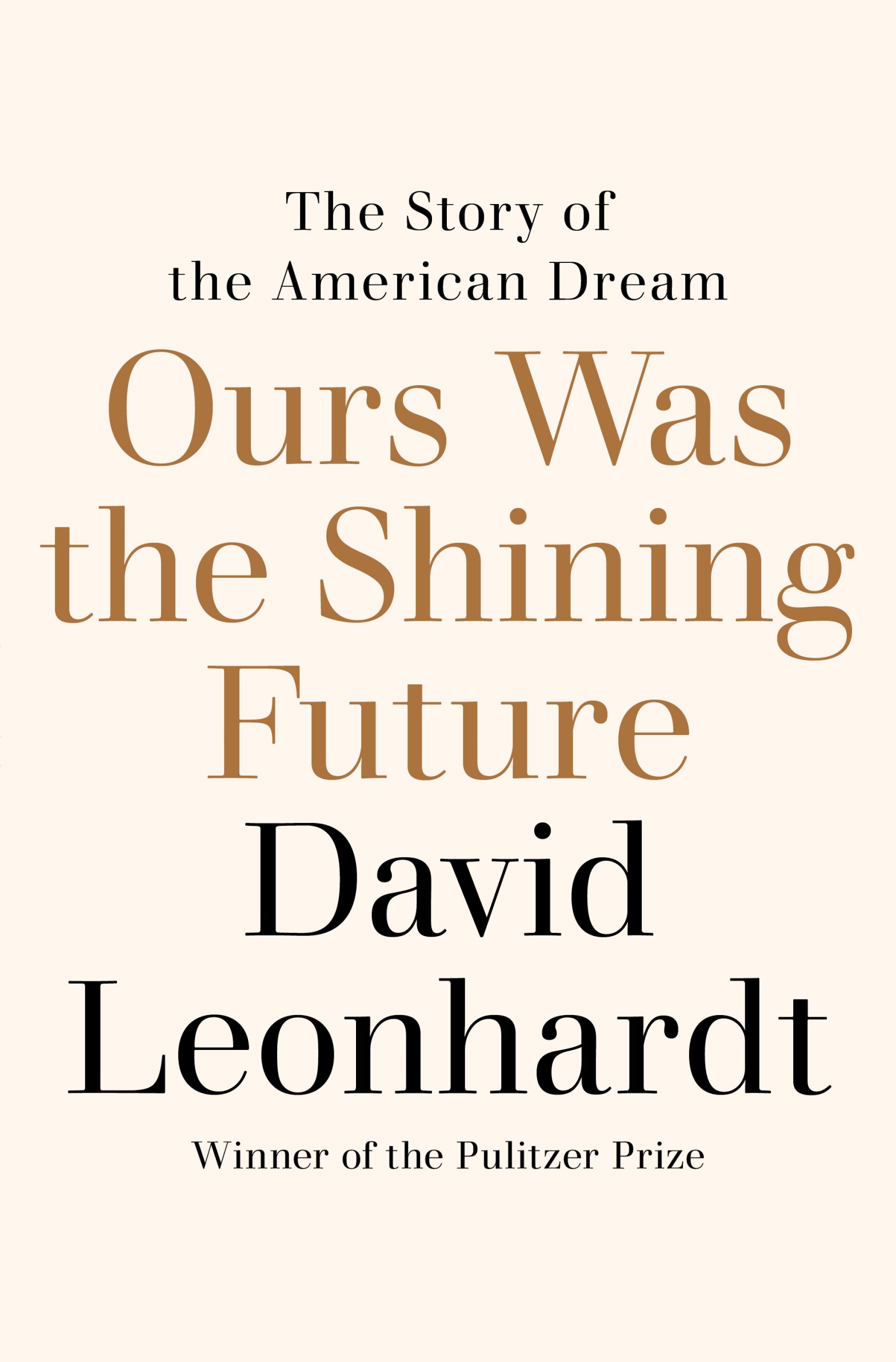
I just finished this fine book by David Leonhardt, a New York Times writer who has won the Pulitzer for his commentary in the past. It’s hard to imagine that a book about the history of America’s economy would be anything other than a text book type of read. He covers organized labor, immigration, the tug and pull of politics from the left and right, and the impact on what used to be called the American Dream. Leonhardt does it so well that I found myself taking notes, writing in the columns, dog-earing pages that I wanted to come back to in order to write this blog. I can’t resist sharing some of it….
Some of the lessons from history are instructive (as ever). I noted that when Eisenhower was elected he selected a cabinet made up of “nine millionaires and a plumber,” Ike’s choices were a departure from previous administrations – he chose wealthy corporate executives like the CEO of General Motors, Charles Wilson. When asked whether this might represent a conflict of interest, he famously said “I thought that what was good for the country was good for GM, and vice versa.” Stop me if any of this sounds familiar.
The book takes great pains to discuss how organized labor made an impact – workers could band together to improve their lot with their companies. A worker has little to no negotiating power with his employer, but a group of workers, represented by his union can suddenly command some negotiating power. Some history is instructive on this, but even more interesting is the impact on politics. The Democrats (the “left”) used to be the party that got credit for representing the interests of the working man (or woman). Some time after the 1960s, what Leonhardt calls the “new left” took their eyes off this ball. The New Left failed to create an enduring mass coalition. It didn’t even try. The New Left appealed to college-educated intelligentia. They focused on winning court cases about social issues, with judges who also came from privileged backgrounds. In the meantime, the political right, especially the religious right, stepped into the void and won grassroots victories.
The New Left believed that if college students and professors led the way, the rest of the country would follow. Less than 10% of people in the country held college degrees in the ’60s, and even today it’s only less than 40%. The New Left’s vision was not particularly attractive to most Americans. It was liberal and secular. It was not overly comfortable with patriotism. It was an elitist movement. Therefore – no surprise – college graduates moved left and working class voters moved right. This New Left has created a legacy of political activism. These activists tried to shift public opinion and pressure Congress to pass new laws. They have had success – protecting consumers from harm, reducing pollution, winning new rights for women, people of color and the LGBTQ community. However, the New Left movement never made mch of an attempt to improve the pay, benefits and job conditions of working-class Americans.
Thus the narrow focus of the New Left no longer had a mass movement to lift most Americans’ living standards. The left had split into two movements – a progressive elite movement and a group of largely self-interested labor unions. Many workers naturally began to question where their political loyalties should lie.
Along came Reagan – with his folksy charm and appeal to the common man, he swept into office with the power to change the key elements of the American economy. However, one of the key failures of this period is that this is when wealth began flowing to a relatively small and affluent segment of the population, while everyone elses grew more slowly. Reagan helped end the weak overall growth of the 1970s, but he ushered ina new era of unbalanced growth. His presidency invigorated the stock market and the financial well-being of the wealthy. For most families, however, it failed to deliver on its promise.
Okay let’s talk about immigration for a bit. Leonhardt’s chapter on this topic is educational. In the late 1960s, the foreign-born share of the US population was below 5%. It has since risen – I looked it up – to 15.6% in March of 2024. Immigration is a particularly thorny issue with a great deal of complexity. Questions of “who” and “how many” can be broken down. The 1965 immigration law did a poor job of anticipating its effects. It allowed relatives of residents, and those with key skills to enter the country and effectively opened the floodgates inadvertantly.
Immigrants have done well in the US, to a great extent. Leonhardt explores why – they show up with grit and ambition; more than some citizens. They have already shown a willingness to uproot and move, which most Americans prefer to avoid.
President Clinton asked Congresswoman Barbara Jordan to lead a commission on the issue of immigration strategy. She said “immigration is not a right, guaranteed by the US Constitution to everyone anywhere in the world who thinks they want to come to the United States. Immigration is a privilege. It is a privilege granted by the people of the US to those we choose to admit.” She said that a country should guard its borders and declared that this is about the definition of America. She made different recommendations for legal and illegal immigration. She was pro-immigrant without always being pro-immigration. Clinton supported her work….briefly. The Democrats leaned more toward allowing people in than guarding the borders. The problem with that is that most people in the US didn’t agree. The New Left decided that more is better and less is racist. They ignored Jordan’s finer definitions on who should be allowed in.
Leonhardt talks about the “Brahminism” of the left. He says that they appealed to educated people, particularly on social issues, and largely ignored economic ones. Immigration became a real blind spot for the left, leaving people to gravitate rightward.
Education is another topic treated in this book. The author calls education “the investment that turbocharges every other investment a society makes.” At one point, American investment in education led the world. Providing free education for all students set us apart. The rest of the world were slow to copy but they eventually did, and many have surpassed the US. The share of young adults receiving bachelors degrees (which is where earnings increased dramatically) more than tripled from 1970 to 2000 in South Korea and more than doubled in Belgium, Ireland, Poland, Spain and Japan. It rose more than 50% in UK, Denmark, Norway and Sweden and more than 30% in Canada. The US seemed to lose faith in its own strategy and the share of people receiving a bachelor’s degree rose only slightly during those 30 years. The US is no longer the most educated country….and wages have – not coincidentally – also grown slowly since the 1970s. The US shifted budgetary investments to the healthcare sector, the largest prison network and a safety net that often benefits the affluent.
An interesting observation made in the book is that the countries who lost and were ravaged by wars were faring better economically in the days after, ie Germany and Japan versus UK and USA. Its almost like they wiped the slate clean (or we wiped their slate clean, to be more accurate). They then rebuilt their economies and political systems because special interests were so weak. Germany and Japan rose because of their loss, not in spite of it. It seems to me that they are past that phase now and their own special interests are as combative as those in the US and UK at this point.
Note that the US has turned the tide in two world wars, developed the polio vaccine, built the auto industry, created the modern computers, launched the jet age, landed on the moon, pioneered mass education at high school and college and forged the world’s largest middle class. This is American exceptionalism as many have called it.
The author suggests that the culture has changed and investments in the future have stagnated. Our workers have little influence on the economy and the political system and the culture is individualistic and angry now, rather than community oriented and hopeful as it used to be. The American dream – when each generation would do better than their parents – seems to have evaporated. I read recently that a prominent Canadian believes he is witnessing the decline of the American empire. It makes me sad.
The political left (of which I am probably a part) is now more focused on social issues that appeal mostly to professionals. The political right dedicated enormous resources to influencing the working class…though one could question whether this was in service of creating mass prosperity. Progressives will need to find a way to listen to the views of working class Americans and be more inclusive of those beyond white-collar professionals, if they expect to compete. People like vote because our politics is about more than our personal finances. Poor and working class people may also feel this way but they recognize that the “Brahmin” left has stopped engaging with them and listening to them.
I have wandered about through a variety of topics treated in this exceptional book. I also believe I learned a lot. Now the question is what do I do with this.
 mikesteinharter.com